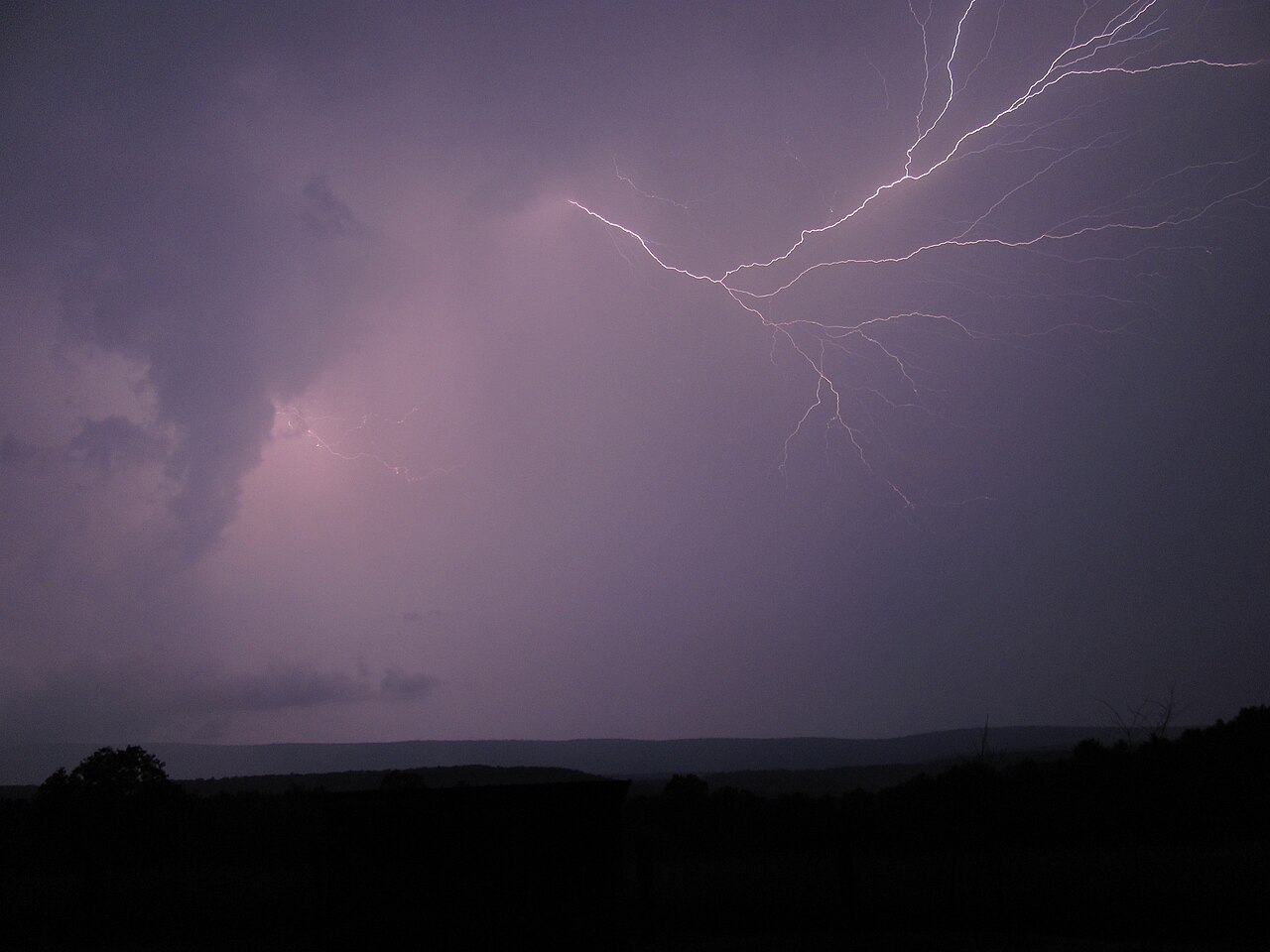
Lightning does not need a direct hit to kill. Roughly half of lightning injuries and deaths happen through ground current, side flashes and conducted current — mechanisms that make an isolated tree, a metal tent pole or a shallow rock alcove deadly even when the bolt lands elsewhere. Thunderstorms on exposed terrain give you minutes, not hours, and the difference between a story and a fatality is almost entirely timing and position. This guide gives you the physics you can use in the field: flash-to-bang counting, the 30/30 rule, the terrain positions that are genuinely safer, the crouch of last resort, and what to do the moment someone is struck.
How lightning actually hurts hikers
When a bolt strikes a tree or a ridge crest, its current does not politely disappear into the ground at one point. It spreads outward through the surface in all directions as ground (step) current, and voltage differences between your two feet — or between hand and foot — drive that current through your body. A side flash jumps from a struck object to anyone sheltering close by, and current can also travel along fences, cables, wet ropes and water. Direct strikes are the minority of casualties. This is why “not the tallest thing around” is necessary but nowhere near sufficient: you must also avoid being near the tallest thing, connected to conductors, or standing where surface current concentrates.
Flash to bang: count seconds, know the distance
Light reaches you effectively instantly; thunder travels at roughly 343 metres per second in air. Two field-friendly conversions follow directly:
- Every 5 seconds between flash and thunder ≈ 1 mile of distance.
- Every 3 seconds ≈ 1 kilometre.
As the calibration example built into this site's timer, a 15-second flash-to-bang gap means the strike was about 3 miles / 5 km away — close enough that the next bolt could already be on top of you, because individual cloud-to-ground strikes regularly hit 3–5 km (2–3 miles) out from the rain core, in seemingly clear air. Count from the flash you see to the thunder's start; don't wait for the rumble to end.
The counting drill
Start counting the moment any flash is visible, even distant “heat lightning.” If you cannot make out individual flashes because the storm is flickering continuously, treat it as already inside the danger ring. The lightning safety timer converts your counted seconds to distance and tracks both 30-minute clocks so the group does not have to do arithmetic while nervous.
The 30/30 rule: get in, and stay in
The operational rule adopted by weather services worldwide has two halves:
- 30 seconds: when flash-to-bang is under 30 seconds — the storm within roughly 10 km (6 miles) — immediately move to a substantial, fully enclosed building or, failing that, a fully closed metal-roof/metal-body vehicle with windows up. A car protects through its conductive shell, not its rubber tires. Open shelters, picnic pavilions, porches and trail huts with exposed openings do not count.
- 30 minutes: after the last sound of thunder (and last visible flash), wait a full 30 minutes before resuming exposed activity.
The half everyone violates
The first half saves groups who react; the second half is the one that kills people who relax. Blue sky overhead and sunlight on the trail do not end the danger — strikes from the storm's trailing anvil regularly land after the rain stops and thunder has grown faint. A large share of late-storm casualties are people packing up “since it's over.” The clock resets with every single thunderclap, no exceptions.
Where not to stand: the terrain hit list
Backcountry shelters are usually unavailable, so position becomes everything. Move off high ground first, then avoid the secondary traps:
| Position | Why it is lethal | Move to |
|---|---|---|
| Isolated tall tree | Direct-strike target; side flashes and ground current kill anyone close | At least 2× the tree's height away; prefer a uniform low-forest area |
| Ridge, summit, lookout rock | Highest point in a wide radius | Descend off the crest to lower, rolling ground |
| Open meadow / lake shore | You become the tallest object; water conducts | Low ground amid evenly sized brush or small trees |
| Cave mouth, rock overhang, alcove | Current arcs across the gap and through occupants via ground current | Deep cave passages well beyond the entrance, or open low ground |
| Fences, poles, cables, wet rope | Conduct current over long distances | Put many body-lengths of distance between you and metal |
Spread groups out several metres apart: this reduces one flash injuring everyone and keeps rescuers available.
The lightning crouch: last resort, not shelter
With no safe enclosure reachable and seconds remaining, minimize your contact with the ground and your height. Place a foam sleeping pad, empty pack or dry rope under you as insulation, then crouch low, feet together, knees drawn up, head down, hands over ears or around knees — and do not put hands on the ground, lie flat, or let two widely separated body points bridge voltage. Feet together minimizes the step-voltage distance current can exploit. Treat this as desperation, not a plan: it lowers odds, it does not make exposed ground safe.
Camp and tent tactics
A tent provides rain, not lightning protection; fabric shelters have no conductive shell, and a strike to nearby ground reaches occupants through wet material, poles and the floor. In an active storm leave the tent and its pole structure, move away from the tent as you would from any isolated object, and assume the crouch on insulating gear in lower brush away from tall trees. Choose campsites the night before with this in mind — not on a saddle, ridge lip, lake shore or under the one towering pine — because at 2 a.m. in a storm you will not relocate intelligently. Remove metal-frame packs and trekking poles from your immediate vicinity.
Beat the storm: signs and planning
Thunderstorms in mountain terrain typically build through the morning and fire in early to mid-afternoon, so the safest summit hours are early ones. Watch for the 30-minute warning signs: tall building cumulus growing vertically into dark-based anvils, sudden stillness or a cold wind shift, distant rumbles, and a sharp drop in temperature — any of these should start your descent from exposed ground immediately, before you can count to ten. Before the trip, check the mountain weather kit for thunderstorm probability, freezing level and wind at summit elevation, and build turnaround times around the forecast peak, not the summit register.
If someone is struck: they are safe to touch
A lightning victim does not retain an electrical charge — there is no danger in touching them, and delay is the real killer. Move them only if the position remains exposed to further strikes; otherwise check breathing and pulse immediately and begin CPR if either is absent, using an AED if one can be fetched. Lightning casualties often present with cardiac or respiratory arrest, confusion, ruptured eardrums, numbness and superficial burns; survival after prompt CPR is common. Assign someone to call emergency services (911 / 112 / 120) with coordinates, triage the quiet victims first — they may be the most badly hurt — and keep everyone in safe positions until the 30-minute clock finally completes. Keep the lightning safety timer running from the first flash so the whole party shares one clock.